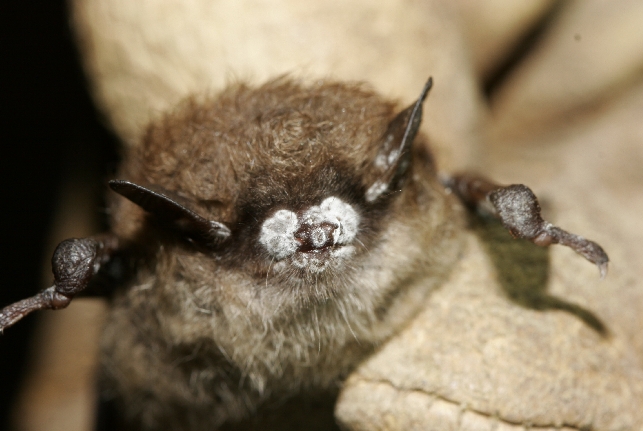
White
Nose Syndrome (WNS) is a disease associated with the deaths of “at least 5.7 to
6.7 million North American Bats.” The disease is named after the distinctive
fungal growth around the mouth and nose of bats. WNS was first discovered in
the Schoharie County of New York in February 2006, but has grown to hundreds of
caves all over the United States as of 2013.
“It
is believed that Pseudogymnoascus
destructans is the sole cause
of the disease.” The white fungal growth around the bats mouth was analyzed
microscopically, to find that it is a form of the Pseudogymnoascus destructans, which is the fungal infection
associated with WNS.

White
Nose Syndrome has greatly decreased bat populations in caves throughout North
America. Some species of bats have already been listed as endangered. Bats play
a big part in our environment. Without bats, “at least 2.4 million pounds of
insects will go un-eaten and become a burden to farmers, possibly leading to
crop damage.” – The United States Forest Service
North
American bats are reaching a death toll of 7 million. Scientists are starting
to find evidence about the fungal infection, and have come to conclusion that
WNS fungus can survive in caves without the presence of bats.
Scientist,
Hazel Barton (University of Akron professor), led the most recent research
studies. One issue they found was that WNS not only lives around the muzzle,
but also ears and wings, giving the bats “the appearance like they’ve been
dunked in powdered sugar.”

The UA professors held a comparison of WNS to other
cave dwelling relatives, and it was suggested that two closely related fungi
share the same nutritional needs (found in cave soil) and are being transferred
to the bats.
"Barton and her colleagues are zeroing in on when
the fungus transferred from environment to bat and the consequences of the
fungus' relentless ability to survive solely in caves, uninhabited by bats."
The article was very well written, but lacked more
information about WNS itself, so I researched it a bit. Hopefully the
scientists can figure out when the transfer of fungi happens, to help save millions
of bats!
Article:
http://www.sciencedaily.com/releases/2014/01/140129135108.htm
Wiki Page:
http://en.wikipedia.org/wiki/White_nose_syndrome